
GM GUIDES
Improve Player Engagement with Cast Analysis
Understand table dynamics using real conversation data from your TTRPG sessions
Published: December 2, 2025·Updated: October 19, 2026·9 min read
By Greg H. & Greg W., co-founders of Archivist
← Back to GM Guides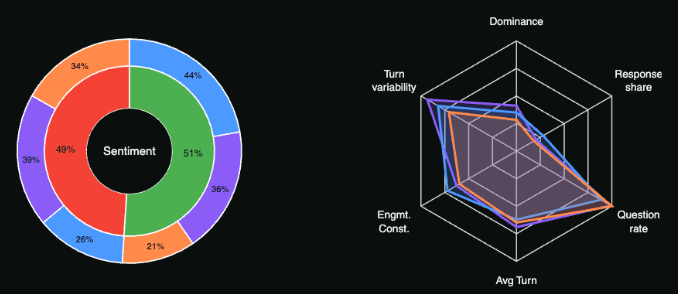
What Cast Analysis Is
Cast Analysis is a participation dashboard generated from your session transcript. It tracks who spoke, how often, how turns moved around the table, and how emotional tone shifted across the session. It also builds a scorecard for each player and shows Pair Dynamics: which players lift each other's energy and which trade off.
It works for any RPG system because it's based on conversational behavior, not rules mechanics. D&D, Pathfinder, Call of Cthulhu, and story games all work. If there's a transcript, there's data.
Case in point: One player kept fading in the last hour of nearly every session. I assumed they were just quiet, but the data showed a repeatable drop in word count, turn length, and sentiment after the midpoint. We added a mid-session break, and the issue cleared up almost immediately.
Table-Wide Metrics
These are the top-level numbers for balance, pacing, and energy across the full session.
How much of the conversation each player owned. High numbers show who dominated; low numbers show who got squeezed out.
How fluidly the floor moved around the table. Low rotation means turns kept returning to one or two people; high means broad engagement.
A single number for how evenly distributed participation was. High imbalance means a few people drove most of the conversation.
Shows when each player was active or quiet across the session. The clearest view of pacing dips, dead stretches, and late-session drop-off.
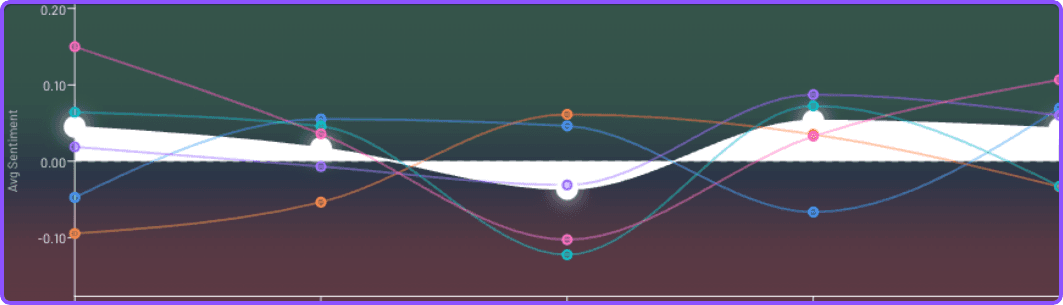
Tracks emotional tone across the session, including excitement, tension, frustration, and positivity. Shows which scenes energized players and which ones dropped the mood.
Player Participation Metrics
Six metrics, one profile per player:
How much floor time a player controls. High values aren't automatically bad, but extreme values usually mean someone else is being crowded out.
Short punchy turns vs. long narrative ones. Where you see high values and slow pacing together, monologues are usually the culprit.
How often a player responds to or builds on what others say. High response share usually means they're holding the conversation together.
Players who ask questions drive discovery. A low rate suggests someone who waits to be prompted; a high rate marks curious, proactive participants.
Steady participation vs. spikes. Spiky patterns usually mean a player tunes in for certain scene types and checks out for others.
How much a player's turn length varies. High variability means their engagement shifts significantly between scene types.
Speaker Scorecards
Participation Stats
ContributionLines spoken, total words, and percentage share of the table's conversation.
Questions & Responses
InteractionHow many questions they asked, how often they answered others, and whether they helped drive discussion.
Turn & Silence Patterns
PacingAverage turn length, longest silence stretch, and whether their engagement was steady or spiky.
Sentiment Contribution
ToneWhether their contributions tended to raise or lower the emotional tone of the table.
Scorecards replace gut feeling with actual numbers. You can see exactly where each player sat relative to everyone else.
Correlations and Deeper Patterns
Individual metrics describe one player. Cross-metric patterns describe your table. Some of the most useful things Cast Analysis surfaces are relationships between numbers that would never show up in a single chart:
- High question rate plus consistent engagement: curious players almost always stay present. They're investing, not just waiting for their turn.
- Low talk share plus high response share: some of the most engaged players at your table aren't the loudest. They respond thoughtfully, but they don't often initiate.
- Sentiment spikes tied to specific players: some players reliably lift the room when they speak.
- Dominant players clustering activity early: some players front-load their participation and fade later.
- Tone dropping when the spotlight shifts: some scene handoffs lower the room's energy.
These aren't things you can track in your head during a session. That's the point.
Engagement Momentum & Pair Dynamics
Most engagement metrics treat players in isolation. Pair Dynamics measures the relationship between players, which is often where the most actionable signal shows up.
Engagement Momentum
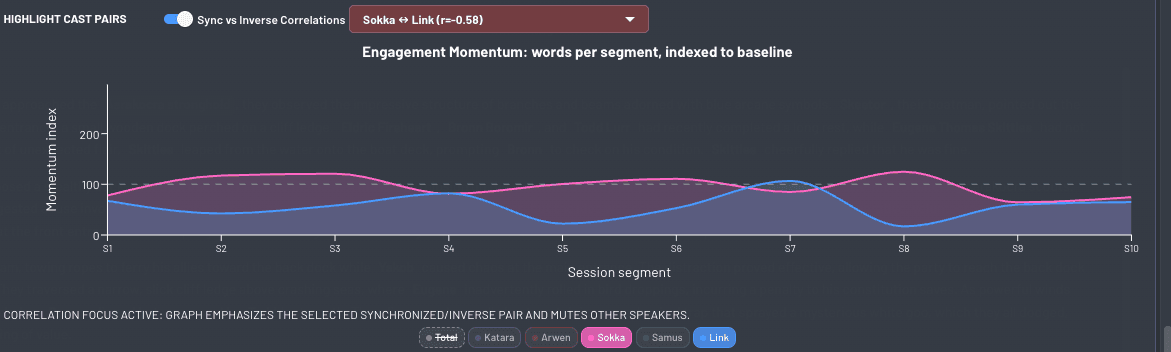
Engagement Momentum indexes each speaker's word output per segment against their own baseline. A score of 100 is normal for that player. Above 100 means they're more active than usual; below means they've pulled back. This tells you not just who was quiet, but when they were quiet, and whether it was a stable pattern or a one-scene dip.
Pair Dynamics
Pair Dynamics measures how two players' momentum curves relate across the same segments. Two patterns emerge:
When one player is active, the other tends to be too. These pairs feed each other's energy and lift the table together. When they're both off, you'll feel the session flatline. Introduce a decision point or direct GM engagement specifically when both go quiet at once.
When one player rises, the other recedes. That usually points to a spotlight tradeoff: two players are drawing from the same conversational space or thriving in the same scene types. This often shows up between a more assertive player and a quieter but equally capable one.
Co-Presence & Spotlight Gap
These segment-level counts answer a direct question: how often were both players genuinely active at the same time (co-presence), versus how often was one dominating while the other had pulled back (spotlight gap)? A high spotlight gap means one player repeatedly ran the scene while the other sat out.
The GM punchline
An inverse pair with a consistently high spotlight gap usually means scenes built for one player leave the other out. Sometimes that comes from personality, and sometimes it comes from scene structure. You can give each player separate moments, or build scenes that require both to contribute.
Turning Insights Into Action
Numbers don't matter until they change something. Each of these patterns connects what you're seeing in the data to a concrete adjustment at the table.
Spotlight Imbalance
SpotlightSignals: Talk equity is skewed, one or two players have very high talk share, and their dominance scores are noticeably higher than everyone else.
What it means: A small number of players are driving most scenes, while others get little time on the mic.
How to respond: Design scenes that explicitly invite quieter players. NPCs can address them by name, or plot hooks can tie directly into their character arcs. Build encounters with multiple decision points that require input from different players.
Slow or Lopsided Pacing
PacingSignals: Turn rotation is low, average turn length is high for one or two players, and the activity timeline shows long stretches where others are quiet.
What it means: Conversation is bouncing between a small set of voices, and long turns are dragging overall pacing.
How to respond: Add more distributed decision points and break up long monologues with reaction beats. Use mechanics or structured turn-taking in key scenes to give quieter players a defined opening.
Quiet but Highly Responsive Player
EngagementSignals: A player shows low talk share but high response share, with solid sentiment and engagement consistency.
What it means: They rarely initiate, but they respond thoughtfully when brought into the conversation. They are engaged, just not self-forward.
How to respond: Give them direct prompts and structured opportunities to participate. Let NPCs ask them questions, or build scenes where their character has key information or leverage so they naturally step forward.
End-of-Session Fatigue
FatigueSignals: Engagement is strong early but drops in the last third of the session. The activity timeline flattens, average turn length shrinks, and sentiment dips late.
What it means: Players are losing energy as the session goes on, even if the content is good.
How to respond: Add a short mid-session break and consider tightening your overall session length. Place important scenes earlier and use the final stretch for lighter, lower-stakes beats so energy doesn't crash before you wrap.
Low Curiosity and Questioning
DiscoverySignals: Question rates are low across the table, and you see few players asking for details, clarification, or options.
What it means: Players are waiting to be led rather than driving discovery. They're not asking questions because they're not sure their curiosity matters.
How to respond: Lead with mysteries and investigative scenes where asking questions has clear payoff. When a player asks something and gets something useful back, others start asking too.
Combat Frustration and Tone Drops
ToneSignals: Sentiment over time dips specifically during combat segments, even if the rest of the session trends positive or neutral.
What it means: Combat may feel too long, too difficult, or unclear in its stakes. Players might be bored, confused, or frustrated.
How to respond: Tighten rounds, reduce unnecessary complexity, and add more reactive elements that let players see immediate results from their choices. Use sentiment swings to spot which encounter styles land well and which ones consistently drag morale.
FAQ
How can I improve player engagement at the D&D table?
Cast Analysis shows where energy rises or dips across a session. Use it to find scenes that work, scenes that don't, and where to invite more voices.
How do I know if my players are engaged in TTRPGs?
Engagement shows up in talk patterns, not volume. Cast Analysis tracks talk share, turn rotation, and question rates so you can see who contributes consistently, who only speaks when prompted, and where attention drops.
How do I balance spotlight time between players?
Check talk equity to see who drives most scenes. If a few players dominate, design encounters that require decisions from multiple people and give quieter players defined roles. Cast Analysis makes imbalances easy to spot.
How easy is it to get started?
If you already record your game sessions, you're set. Cast Analysis runs automatically using your existing Archivist transcripts. No extra hardware or setup.
Will this change how my players interact?
No. Cast Analysis observes natural conversation patterns in TTRPG sessions so players can speak however they normally do. No behavior changes or special phrasing required.
What RPG systems work with Cast Analysis?
Any tabletop RPG system. Cast Analysis reads conversation, not rules, so it works the same whether you're running D&D, Pathfinder, Call of Cthulhu, or something we've never heard of.
Conclusion
A single session gives you a snapshot. Four or five sessions give you a pattern.
Late-session drop-off, recurring spotlight gaps, or the same inverse pair showing up again and again usually point to table structure, not randomness. If one player keeps losing momentum in the third act, your session structure is probably contributing to it.
Multi-session data also closes the loop. If you adjusted pacing or redesigned how you handle a specific player after session 8, sessions 9 and 10 will show you whether it actually worked. Without the data, "things felt better" is the best you can do. With it, you'll know.
If you want the product walkthrough, setup steps, and feature reference, see the Cast Analysis documentation.