
COMMUNITY AMA
Behind the Screen: AMA with the Founders
A fast look at Archivist’s philosophy, workflow, and product direction.
Published April 12, 2026 • 7 min read
← Back to the Blog Hub
Watch the AMA
A quick founder walkthrough of Archivist’s philosophy, workflow, and product direction.
For the broader philosophy behind this approach, see AI in TTRPGs: Automate the Admin, Not the Story, then watch the full session on YouTube.
Watch on YouTubeOur Stance on Archival AI
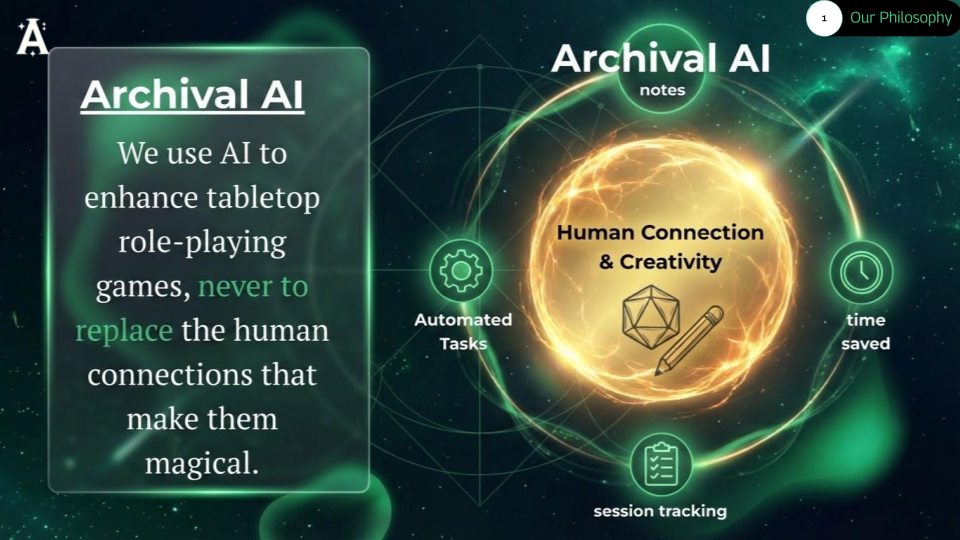
Archivist is built on a simple stance: AI should strengthen the human side of tabletop play, not replace it.
- Use AI to remove distractions and admin work
- Keep a more faithful record than manual note-taking alone
- Create more space for creativity, presence, and storytelling
Your Data, Your Control
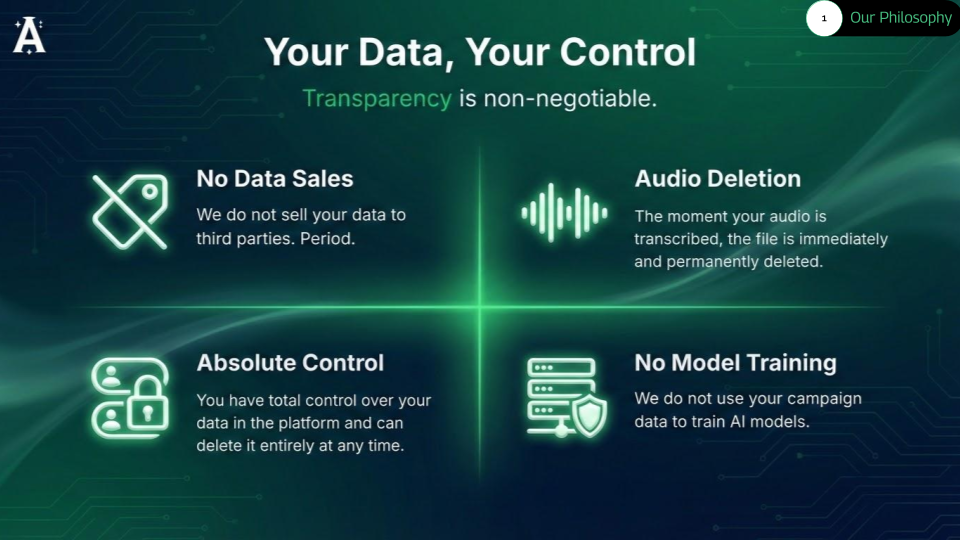
Trust is foundational to Archivist, which is why user control, privacy, and clear boundaries around data are part of the core product philosophy.
- Your group owns its story and IP
- Archivist is not built around data sales or model training on campaign data
- Audio is deleted after transcription to minimize retained data
Why Generic AI Falls Short for Long-Form Campaigns
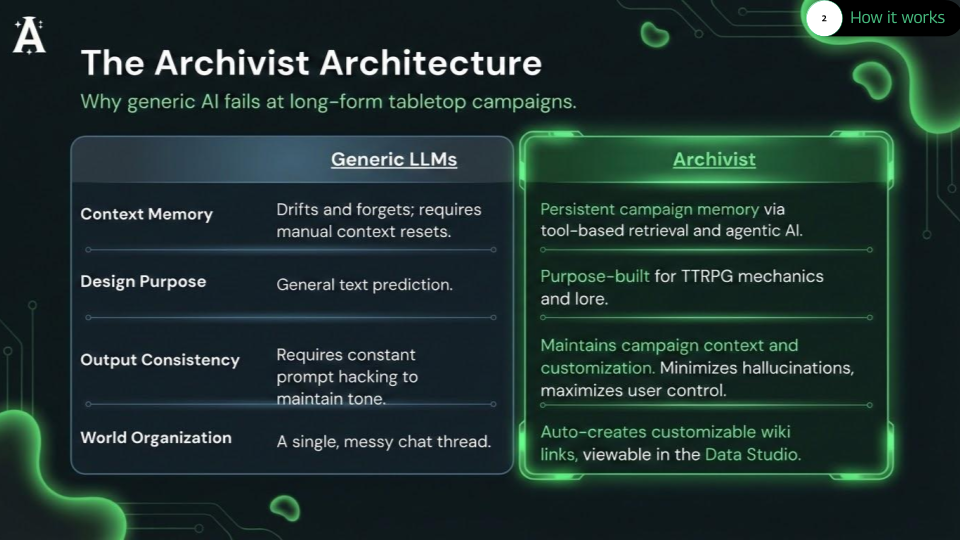
Archivist exists because generic AI tools are useful, but they are not built to reliably support long-running campaign memory and structured TTRPG workflows.
- Generic LLMs drift, forget, and require constant re-prompting
- Archivist is context-bounded to a campaign and purpose-built for TTRPG utility
- The goal is a structured, shareable world instead of a messy chat thread
From Raw Session Data to Structured Campaign Memory
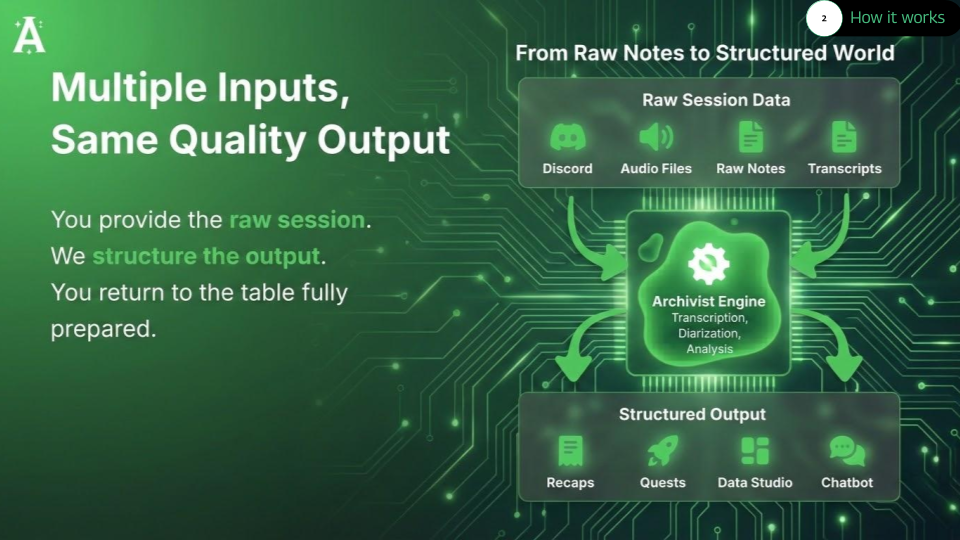
Archivist is designed to take in messy real-world session inputs and turn them into consistent, structured campaign outputs.
- Supports Discord, audio uploads, transcripts, and raw notes
- Transcription, diarization, and analysis happen behind the scenes
- Output flows into recaps, quests, Data Studio, and chatbot answers
Building a Living World Over Time
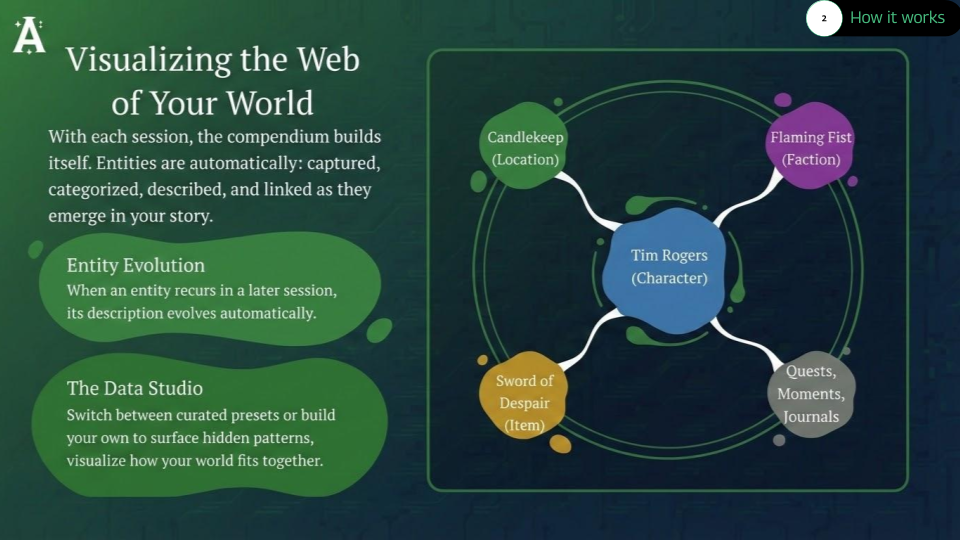
One of Archivist’s core values is campaign-level continuity, where characters and other story elements evolve across sessions instead of being trapped in isolated summaries.
- Tracks characters, items, factions, and locations over time
- Connects those elements with quests, moments, and journals
- Data Studio helps visualize the web of a campaign as it grows
Archivist for Players
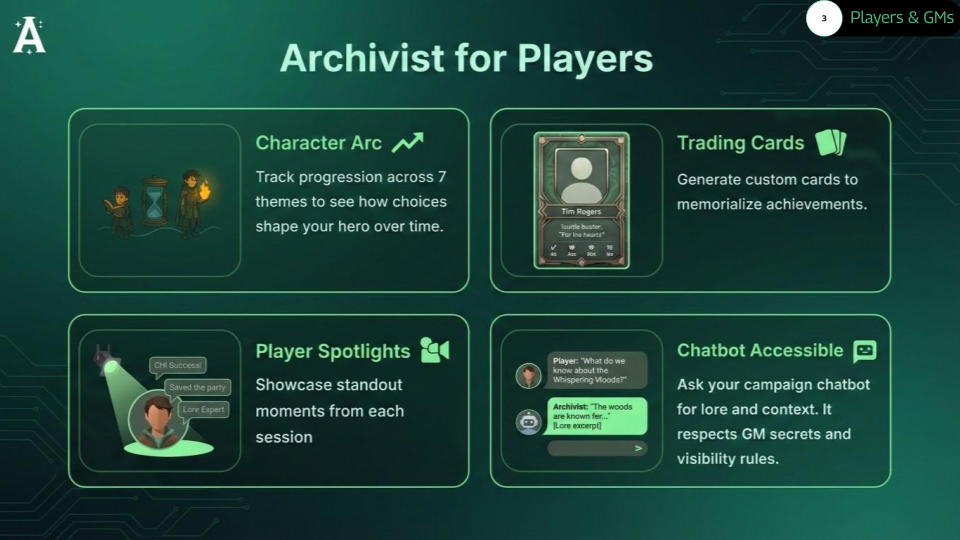
Archivist is not only for GMs, because players also benefit from campaign memory, progression tracking, and self-serve access to lore.
- Character Arc tracks development across seven themes
- Player Spotlights and Trading Cards create keepsakes and recognition
- Players can use the chatbot without constantly interrupting the DM
Artifacts and Shareable Outputs
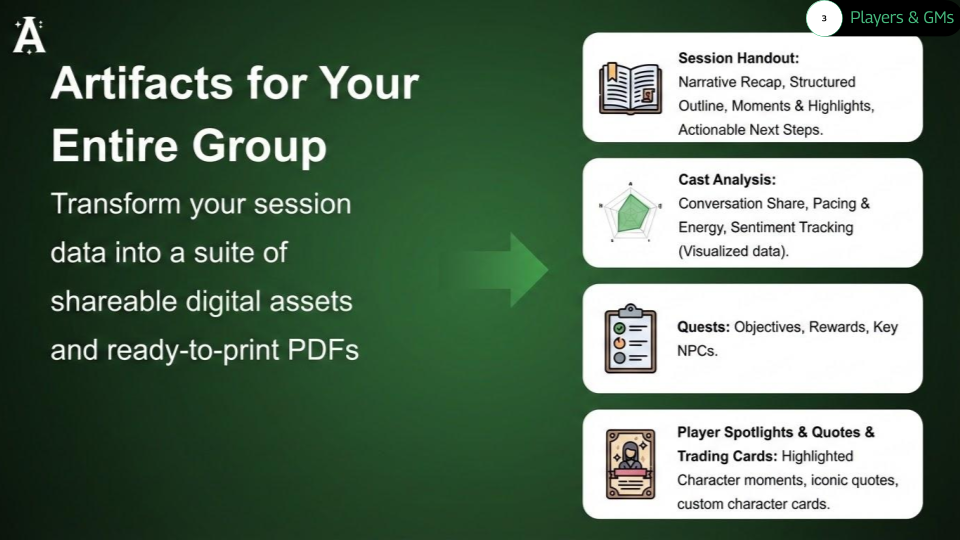
Artifacts turn session data into practical outputs that are easy to share, revisit, and use between sessions.
- Session handouts help absent players catch up fast
- Cast Analysis, Quest snapshots, quotes, and cards add more ways to revisit a session
- Artifacts are meant for both GMs and players
A Connected Ecosystem
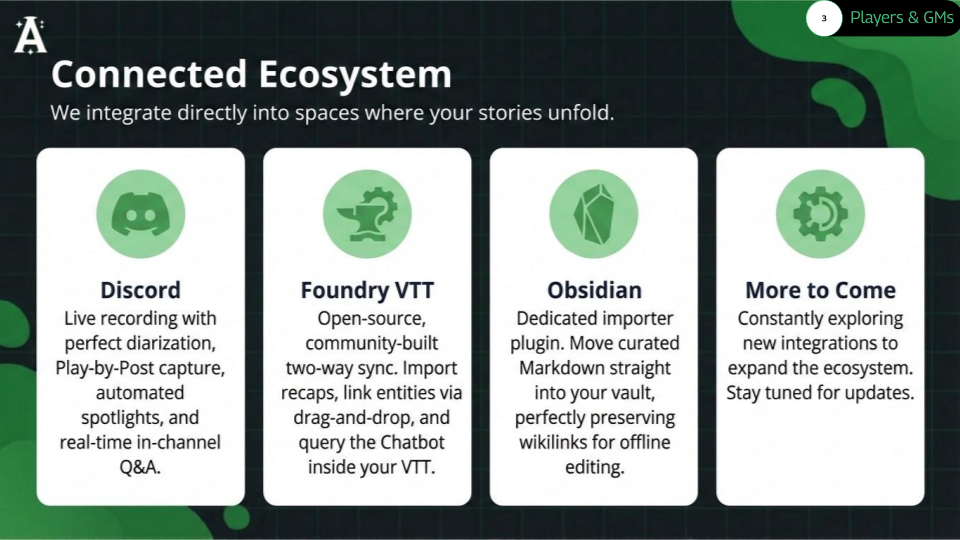
Archivist is being built as a connected campaign data layer that can work across the places people already play and organize.
- Deep investment in Discord, Foundry, and Obsidian
- Goal is broader utility across more surfaces, including in-person play
- Specialized diarization and mobile are part of that expansion
Relentless, Community-Driven Development
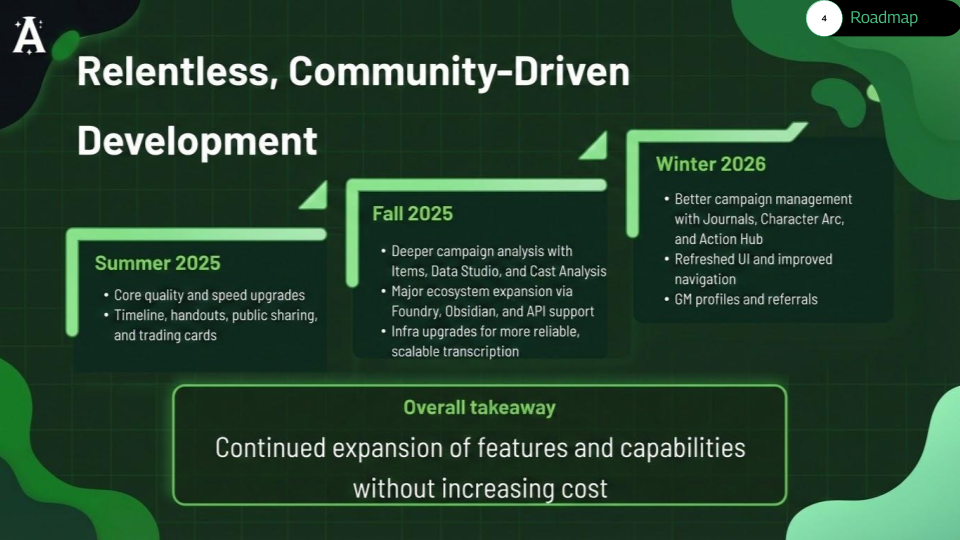
The recent product story is one of fast, community-driven iteration across quality, structure, integrations, and usability.
- Summer 2025 focused on core speed, quality, timeline, and handouts
- Fall 2025 expanded analysis, integrations, Data Studio, and API access
- Winter 2026 added journals, Character Arc, Actions Hub, UI improvements, and GM profiles
Questions and Answers
AMA Questions and Answers
Jump to the section you care about most.
AI Philosophy & Trust
What do you mean by “Archival AI”?
Archival AI is our term for using AI to handle the operational side of tabletop play, things like capture, memory, organization, and other distractions that pull attention away from the table. The goal is not for AI to tell the story, but to help preserve it faithfully so players and GMs can stay more present in the session.
Who owns the story and campaign IP?
The players and GM do. Archivist is there to save time, structure what happened, and help preserve campaign memory, not to claim ownership over the story or reuse it elsewhere.
Could your stance on privacy ever change if the business needed new revenue?
No. These principles are foundational to Archivist. Our view is that growth should come from creating more value for players and GMs and expanding that value into new surfaces, not from monetizing user data.
Why not just use ChatGPT or another generic LLM?
Generic AI tools can be useful, but they are not built for long-running campaign continuity. They drift, forget context, make things up, and usually require constant prompt setup. Archivist is built specifically for TTRPGs, with campaign-bounded memory, structured world data, and outputs designed for actual play.
How Archivist Works in Practice
What kinds of session inputs can Archivist work with?
Archivist is built to meet groups where they already are. That means working from live Discord sessions, uploaded audio, raw notes, and transcripts, then turning those inputs into structured outputs like recaps, quests, chatbot-accessible knowledge, and campaign data.
What are Artifacts, and why are they useful?
Artifacts are shareable outputs generated from your session data, including things like handouts, cast analysis, quest snapshots, quotes, and cards. The idea is to make campaign information easier to revisit, easier to share with the group, and easier to use between sessions.
Is Ask Live available now, and are those questions private?
Yes. Ask Live is already available for Discord recording sessions, so users can ask questions during a live game about what just happened. Ask Private is ephemeral, and Ask Live was described as working similarly, while general bot mentions in a channel are visible to everyone.
Can transcription quality improve, and will users ever be able to keep the audio?
Yes on transcription improvements. We talked about ongoing work to improve transcript quality, especially as we rebuild parts of the audio pipeline. On retained audio, our current approach is still to purge it by design, though we have discussed whether some form of limited user access could make sense in the future.
Players, GMs, and Visibility Controls
Is Archivist only for GMs?
No. Archivist is clearly useful for GMs, but it is meant to support the full table. Players can track their character’s development over time, revisit recaps and campaign lore, use the chatbot to self-serve answers, and access features like Spotlights and Trading Cards without constantly stopping the session to ask the GM for reminders.
Can DMs query private notes and secret information?
Yes. Journals are private by default, and information can be kept private to the GM, shared with the whole group, or even made visible to only one specific player. That makes it possible to support hidden agendas, secret objectives, private lore, and player-specific knowledge without exposing it to the rest of the party.
Roadmap & Product Direction
What would be the first really big change you are thinking of?
The biggest change is less about one flashy feature and more about expanding Archivist into more surfaces. We already have a strong campaign data foundation, and a lot of the next phase is about making that value more broadly useful across different ways people play.
What are the biggest things coming next?
The main roadmap items we highlighted were Player Awards, a centralized Artifacts hub, a rebuilt audio upload pipeline with stronger speaker diarization and multi-track support, and a mobile app. Those are some of the biggest near-term areas of focus, though they are not the entire roadmap.
Are you planning to pull in dice rolls, character sheet mechanics, or more Foundry data?
It is something we are interested in, but it is not the near-term focus. Right now, our direction is narrative-first rather than mechanics-first, so deeper mechanical capture is something we may explore later, but it is not on the short-term roadmap.
What is the mobile app actually meant to do?
The initial goal for mobile is not full session review on your phone. It is easier access to campaign content, chatbot access, and better in-person recording through stronger speaker diarization, so groups can capture sessions more easily even away from Discord.
Founders & Background
Did you already have experience developing applications, or did you start learning because this needed to exist?
Greg H brought the technical background, while Greg W was more on the business side at the outset. Archivist started with that traditional technical and non-technical founder split, but the line has blurred over time as the company evolved.
How is AI playing into your own development and support efforts?
As the tooling has improved, it has significantly expanded what a small team can build, support, and ship. AI has become part of how we learn faster, move faster, and multiply what a team of two can realistically do, even though the actual product itself has also become much more sophisticated over time.
What other projects or ideas did you consider before committing to Archivist?
There were other ideas floating around, including smaller TTRPG-adjacent concepts, but Archivist was the first one that felt like a truly compelling thing to build. Once we saw the need and the opportunity clearly, it became the obvious focus.
What games do you love, and what kinds of RPG design excite you?
We still have a lot of love for 5e, but we have also been enjoying branching out into systems like Call of Cthulhu and, more recently, the upcoming Dungeon Crawler Carl TTRPG. More broadly, we are drawn to RPG design that creates stronger narrative consequences and different storytelling structures.