
How One Archivist User Automated 90% of His Post-Session Workflow with Archivist & MCP
Published June 4, 2026 • 8 min read
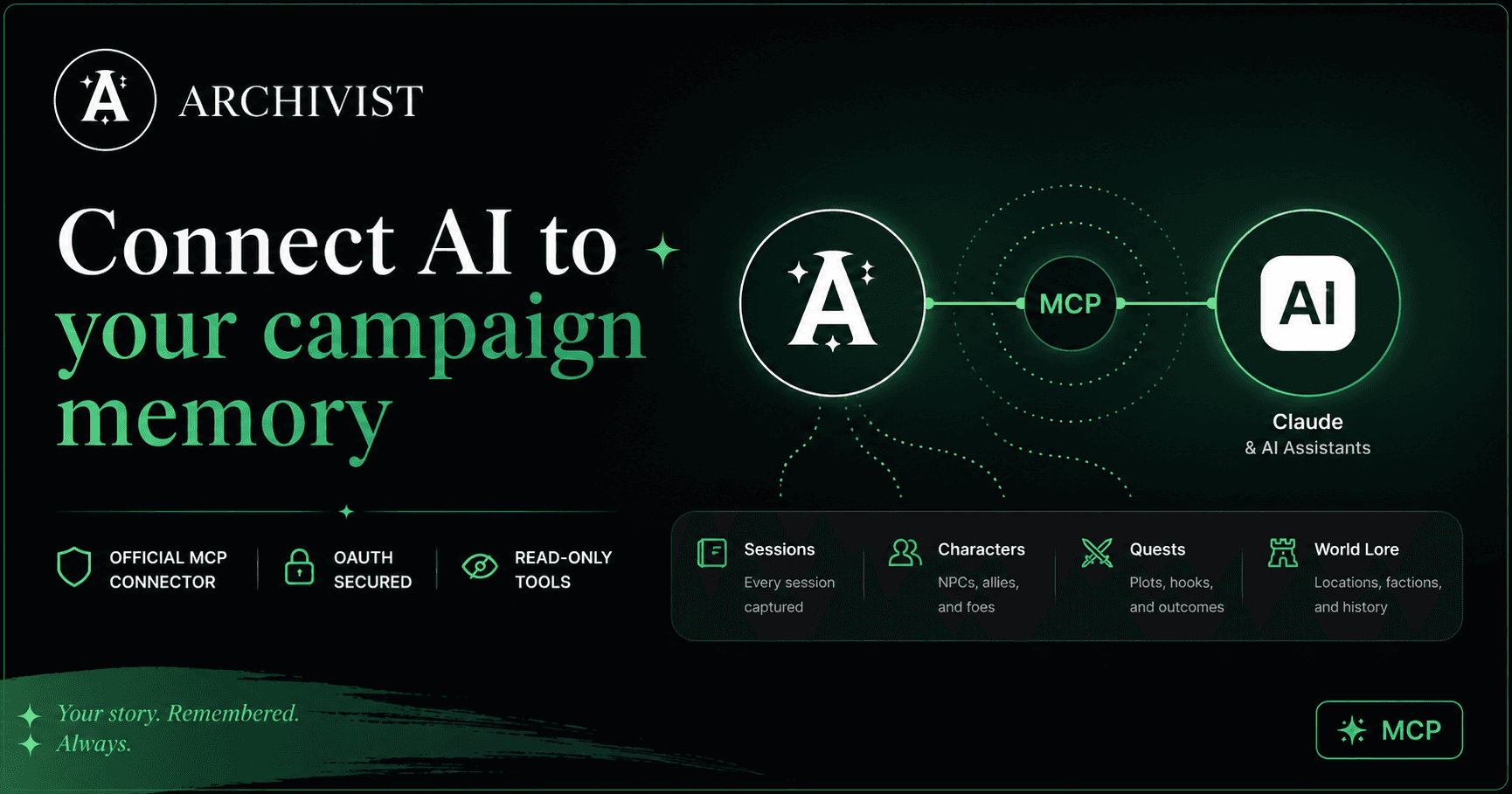
We launched the Archivist API in October 2025, hoping people would use their campaign data outside the app in useful ways.
Tom Herrmann did exactly that. He built the Archivist MCP server to connect campaign data directly to AI tools like Claude, ChatGPT, Cursor, and other MCP-compatible clients. We asked him why he built it, what workflows it unlocks, and where he thinks AI-powered TTRPG tooling is heading.
About Tom: He uses Notion as his campaign brain and has been running the same campaign since 2019. His current toolset includes ChatGPT, Notion AI, NotebookLM, Cursor, and Archivist. He started as a player, is now the DM, and a lot of his post-session time goes into exporting notes, generating recap assets, and moving campaign context into the tools his group already uses.
Discord: Gummibeer
Personal websites: astrotomic.info · gummibeer.dev
Why MCP?
What is MCP and why did it make sense to apply it to how you play tabletop roleplaying games?
Tom: I use Notion as my campaign brain. Our campaign has been running since 2019, and over six years we've accumulated a huge amount of content, notes, and lore. I started as a player using Notion for my own notes; now I'm the DM and my stack includes ChatGPT, Notion AI, NotebookLM, Cursor, and Archivist. Each tool is good at something, but keeping them in sync is difficult, and they don't all talk to each other natively.
After every session I run through the same list: export to Notion, move the Twitch VOD to YouTube, generate session artwork and thumbnails, post summaries to Discord, prep Instagram posts, and run NotebookLM audio recaps. All of it needs the same campaign data. That's where MCP comes in. It lets AI clients pull session summaries, transcripts, handouts, and campaign data from Archivist and use it to automate whatever comes next.
What does MCP unlock that traditional integrations or standalone AI apps don't?
Tom: I can automate my workflows instead of waiting for a custom integration to exist. Archivist stays focused on what it does best, and I route the data wherever I need it: Notion, Markdown, PDFs, or something completely custom.
What was the moment when you realized, “I need this to exist”?
Tom: As soon as I started actively exporting sessions into Notion and backfilling historical sessions. Importing into Archivist was easy; what followed was always another 15+ minutes of copying text, wrapping it in prompt templates, formatting for Notion, and cleaning up. It worked, but it was tiring and error-prone.
Archivist MCP started as a personal project to solve a workflow problem, and it now shows what happens when campaign data is portable across the tools you already use. If you want the technical path, start with the Archivist API docs or the MCP page.
For a faster setup, use Archivist Nexus. It keeps the same vision simple: own your campaign data, connect it to the tools you already use, and spend less time moving information around.
Why Archivist?
Was there a reason you chose to build on top of Archivist instead of starting from scratch?
Tom: I didn't want to build my own audio pipeline. Before Archivist we recorded with Craig Bot and I ran everything through Whisper on a Mac Mini M1. It took forever and you still only had a raw transcript. You needed more tooling on top to extract entities and build useful campaign knowledge. I already liked what Archivist was extracting; I just needed access to it outside the app.
What campaign-management problem were you trying to solve when you first started using Archivist?
Tom: Keeping track of past sessions and maintaining canon and lore. There's no better note-taker than Archivist sitting in the Discord channel writing down every word.
What was the “okay, this is actually useful” moment for you?
Tom: After the first session and one historical backfill. Seeing the generated handout PDF, and watching my players actually enjoy it, was when it clicked.
Post-Session Workflow
What made you decide Archivist needed an MCP integration?
Tom: I had a lot of post-session workflows I was doing manually: generating session cover images, exporting sessions into Notion, running player feedback and coaching workflows. It usually meant opening Archivist, copying information, pasting it somewhere else, and repeating. I wanted to automate as much of that as possible.
What was the first AI-assistant use case you wanted to unlock with MCP?
Tom: Notion. I wanted to automate exports into my campaign workspace.
What could you do with MCP that the built-in Archivist chatbot didn't cover well enough?
Tom: The chatbot is great for asking questions. MCP lets me take the data and use it elsewhere, combining Archivist with other tools and data silos.
What's the coolest moment you've personally had using the MCP so far?
Tom: Gathering all my post-session workflow prompts into reusable templates and connecting Archivist with the other MCP tools I use. I can tell Cursor to process the latest session, wait about fifteen minutes, and come back to a completed Notion page, session artwork for Canva, social media images, and NotebookLM audio files. One click and roughly 90% of my post-session workflow is done.
What kind of GM or player do you think benefits most from this kind of tooling?
Tom: GMs managing their data outside Archivist, or using that data to create more content - images, videos, audio, texts, anything built on top of campaign knowledge.
What workflows become possible once every campaign tool can share context through open protocols?
Tom: Consistency checks, updating world info, generating derived content like character portraits, location mood pics, session artwork, and campaign summaries all get easier. You own the data and can use it wherever it makes sense instead of copying and pasting between tools.
Why Open Campaign Data Matters
A lot of AI tools today generate content that only really lives inside their own interface. Why do you think portability and accessibility of campaign knowledge matters?
Tom: It comes down to one question: who owns the data? A lot of tech companies want to own it because it's incredibly valuable. The same could theoretically be true for Archivist, sitting on hundreds of thousands of TTRPG sessions, transcripts, and campaign histories. Fortunately that's not the direction Archivist has chosen. Users own their campaign data, and making it available through APIs and MCP only makes sense in an AI-driven future. The value isn't having information stored somewhere. It's being able to access and use it wherever you need it.
What are people still underestimating about where this space is heading?
Tom: The ability to connect multiple tools and let AI handle the transformation between them. You don't have to think about data schemas, file formats, or complicated integrations. You tell the AI what you're trying to accomplish and which tools to use, and it handles the mapping and orchestration.
Thank You!
Huge thanks to Tom for building the Archivist MCP server and showing the community what's possible when TTRPG campaign memory becomes programmable.
The MCP Connector, Archivist Nexus, and the Archivist API all point to the same idea: own your campaign data, connect it to the tools you already use, spend less time moving information around, and more time playing.