
Best DM Tools for D&D (and all TTRPGs) in 2026
No single app covers every GM job. Start with Archivist AI for session notes and searchable campaign memory, add a VTT for spatial play, then choose visual tools around your prep style.
Published February 7, 2026 • Updated September 7, 2026
By Greg H. & Greg W., co-founders of Archivist
Introduction
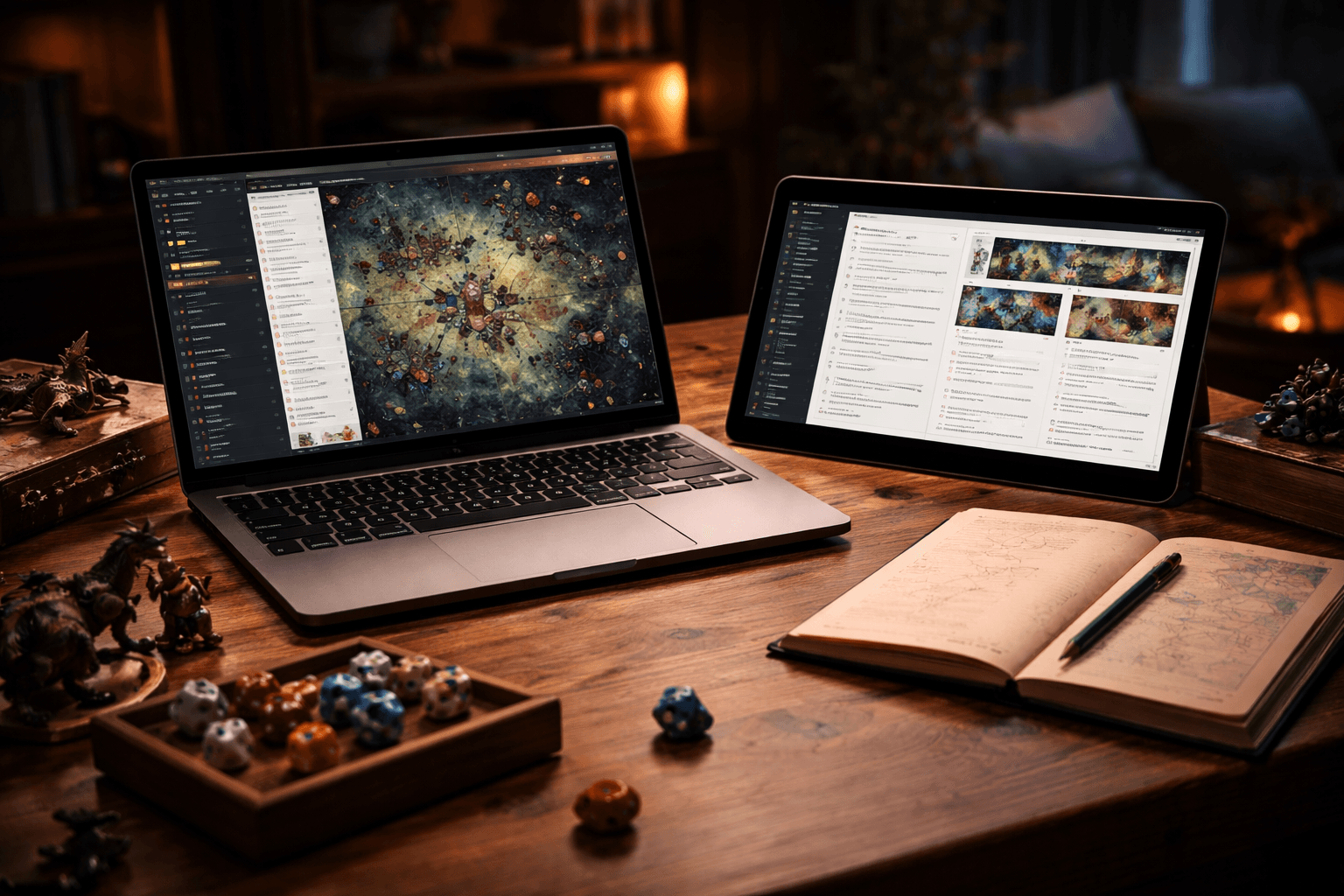
Running a great D&D campaign is as much about information management as creativity. Notes, continuity, maps, handouts, and execution tools determine whether sessions feel smooth or chaotic.
This guide focuses on digital GM tools that materially improve how sessions run, with one free and one paid option per category.
While the examples skew D&D, the tool stack applies to nearly any TTRPG.
If you want a broader AI-specific roundup, start with our AI tools for TTRPGs guide and then return here for the full DM stack.
This post is part of our AI Dungeon Master hub, a set of GM guides and tool breakdowns for TTRPG enthusiasts who want smoother prep and better table flow.
How We Chose These DM Tools
We grouped tools by the job they solve, then selected one accessible free option and one paid option with a meaningful upgrade path. We considered fit for the category, setup burden, time saved during an ongoing campaign, interoperability, and whether the paid tier adds more than cosmetic features.
This guide is published by Archivist AI, and Archivist is our paid pick for Session Notes and Recall. That relationship is explicit so you can weigh the recommendation appropriately. The other products listed here are alternatives for different jobs, not substitutes forced into one overall ranking.
Editorial review: September 7, 2026. Product features and pricing can change; follow each official product link for current details.
How AI Changed the DM Tool Stack in 2026
The six categories in this guide existed before AI. What changed in 2026 is that AI unlocked a practical upgrade path for two of them: Session Notes and Recall, and Handouts and Assets.
Session notes and recall had the biggest shift. Before purpose-built AI DM tools, GMs either kept meticulous manual notes or let continuity degrade over time. AI-powered GM assistants changed this by automating capture, generating recaps, and making campaign history searchable — so the DM can actually retrieve what happened seven sessions ago without digging through notebooks or scrolling Discord.
Visual asset creation got faster too. What used to require outsourced art or hours searching stock images can now be generated from a prompt in minutes — character portraits, NPC tokens, handouts that look like actual in-world documents.
The other four categories — VTTs, worldbuilding tools, map creators, and handout design apps — evolved more slowly. They integrated some AI features, but their core value didn't change: they still solve spatial, structural, and visual problems that a language model can't replace.
Bottom line: If you're adding one AI DM tool to your stack in 2026, start with memory. Everything else multiplies your creativity. Memory ensures that creativity compounds session over session.
Summary Table
A quick comparison to help you pick the right tools by category.
| # | Category | Free Option | Paid Option | Best For | Why Paid Is Worth It |
|---|---|---|---|---|---|
| 1 | Session Notes & Recall | Continuity, recall, and long-running campaigns | Auto recaps and searchable history save prep time | ||
| 2 | Virtual Tabletops | Browser-based play with sheets, dice, and shared maps | One-time license with deep automation and control | ||
| 3 | Character Art & VTT Tokens | Character portraits, token creation, and quick visual identity for NPCs and monsters | Broader generator toolkit, faster asset creation, and a smoother path from character art to playable tokens | ||
| 4 | Worldbuilding & Lore | Reference-first lore and player-facing docs | Advanced maps, timelines, theming, and privacy | ||
| 5 | Maps & Encounter Visuals | Fast map creation and encounter clarity | AI-assisted maps with lighting and VTT exports | ||
| 6 | Handouts & Session Assets | Immersive props and fast, consistent visuals | Premium assets and fast resizing for speed |
1. Session Notes and Recall
What it is: the system that keeps your campaign consistent. This is the most important category for GMs. Forgotten NPCs, lost plot threads, and inconsistent lore break immersion faster than bad combat.
- Helps you remember what the table actually experienced.
- Lets players feel seen when their choices reappear later.
- Builds immersion by keeping the world consistent session to session.
Free option

Google Docs
Reliable, flexible, and familiar. Works well for raw notes, but everything is manual and recall degrades over time.
Open Google Docs →Paid value
This is where tables leak time. Paid tools automate the busywork and keep continuity intact.
- Automatic session summaries and timelines.
- Quest Log for campaign objectives and status tracking.
- Searchable characters, locations, and events.
- Instant recall during play.
Incremental value: saves hours of prep time every month as the campaign grows.
Paid option

Archivist AI
Captures sessions, summarizes them, builds a searchable session history, and includes Quest Log for objective tracking—all for instant recall and continuity.
Explore Archivist AI →For practical workflow ideas, see our guide on speeding up prep with AI.
Why campaign memory ranks first
Archivist's published dataset covers 25,000+ captured TTRPG sessions and 385,000+ campaign entities. Among campaigns that reached 50 or more sessions, the median compendium contained 209 NPCs, 184 locations, 61 factions, and 121 items. That amount of table-created context is why manual recall becomes harder as a campaign grows.
Review the anonymized aggregate data and methodology →Want campaign memory and recall that scales with your table?
Get Started2. Virtual Tabletops (Combat and Spatial Play)
What it is: the digital table for combat and spatial play. Positioning, initiative, and visibility are where confusion slows games down.
- Theatre of the mind is great, but not for everyone.
- D&D movement and positioning matter, so visuals keep mechanics honest.
- A shared map boosts immersion and cuts rules disputes mid-combat.
Free option
Roll20
A browser-based VTT with character sheets, dice rolling, and shared maps built in.
Open Roll20 →Paid value
Paid VTTs reduce session friction with stronger automation, lighting, and custom tooling.
- Advanced lighting and vision.
- Automation via modules and macros.
- Self-hosted control for performance and privacy.
Incremental value: improved visual immersion without ongoing subscription costs.
Paid option
Foundry VTT
Self-hosted VTT you run on your own machine or server, with full control over mods and performance.
Explore Foundry VTT →If you want a deeper look at Foundry workflows, check out our Foundry VTT integration interview.
3. Character Art and VTT Tokens
What it is: the visual identity layer for your campaign. This category covers character portraits and tabletop tokens that make NPCs, monsters, and player characters easier to recognize at a glance.
- Distinct visuals help players remember who is who.
- Tokens reduce confusion in online combat and crowded scenes.
- Strong character art makes recurring NPCs more memorable.
Free option

2-Minute Tabletop
A practical free option for turning character art into usable tabletop tokens. Best when you already have an image and want a quick path to something playable.
Open 2-Minute Tabletop →Paid value
Paid tools help when you want more than token framing. They speed up the full workflow from idea to portrait to token-ready asset.
- Generate character and creature visuals faster.
- Keep art direction more consistent across a campaign.
- Get much higher or uncapped generation headroom, so portrait iteration is not cut short by credit limits and cooldown waits.
Incremental value: faster visual prep and more consistent character presentation across sessions.
Paid option

CharGen
A strong option for GMs who want a broader visual toolkit for character art, tokens, monsters, and other prep assets in one place. While we're listing it as the paid pick in this category, it also offers an introductory free path, making it easy to test before committing.
Explore CharGen →4. Worldbuilding and Lore Repository
What it is: your long-term lore source of truth. This category covers intentionally written content, not session-derived data. It is reference-first and changes slowly.
- One place to build your world and prep future content.
- Connected lore is easier to revisit after time away.
- Consolidation reduces contradictions and half-finished ideas.
Free option
Notion
Flexible pages and templates make it easy to store lore, factions, and NPCs in one place.
Open Notion →Paid value
Paid lore tools add structure and presentation so players can browse without breaking immersion.
- Advanced maps and multiple timelines.
- Custom theming and layout control.
- Granular privacy for in-world reveals.
Incremental value: cleaner lore management plus player-friendly publishing.
Paid option
World Anvil
Built for worldbuilding with structured templates, timelines, and player-facing publishing tools.
Explore World Anvil →If you care about how structure changes recall, our tags and maps guide is a good companion read.
5. Maps and Encounter Visuals
What it is: the prep layer for tactical clarity. Visual clarity improves decision-making and speeds up combat. This category is about preparation, not runtime memory.
- Maps are prep assets, separate from the VTT runtime.
- They communicate cover, distance, and terrain instantly.
- Clear visuals speed up decisions during tense encounters.
Free option

Dungeon Scrawl
Quick sketches for simple encounters when you need speed over polish.
Open Dungeon Scrawl →Paid value
Paid map tools speed prep with AI-assisted layout and exports that drop directly into your VTT.
- Auto-furnished rooms and props.
- Built-in lighting and ambiance.
- Clean exports for VTTs and print.
Incremental value: faster map production with better visual clarity.
Paid option
Dungeon Alchemist
AI-assisted mapmaking that auto-populates rooms with walls, doors, windows, lights, and props.
Explore Dungeon Alchemist →6. Handouts and Session Assets
What it is: player-facing assets that reduce repetition. Props and handouts increase immersion and reduce repeated explanations.
- Handouts make clues and NPCs feel tangible.
- AI can help draft letters, posters, and props quickly.
- Visual aids reduce repeated explanations at the table.
Free option

Google Slides
Simple, shareable, and effective for letters, quest boards, and visual aids.
Open Google Slides →Paid value
Paid tools remove production friction with premium assets and fast resizing for multiple formats.
- Premium templates and design assets.
- Brand Kit and Background Remover.
- Magic Resize for fast exports.
Incremental value: faster handout production with consistent visuals.
Paid option
Canva Pro
Fast templates, consistent styling, and easy export for digital or print use.
Explore Canva Pro →FAQ
What is the single most important DM tool category?
Session notes and recall. Continuity is where campaigns either deepen or collapse, so strong recall tools give you the biggest payoff.
Do I need a paid VTT to run combat well?
Not always. Free VTTs can handle most encounter needs. Paid platforms tend to earn their keep when you want automation, lighting, and long-term customization.
What should I pay for first on a tight budget?
Start with memory. A reliable recap and recall system reduces prep time and keeps your table immersed over long campaigns.
Can I mix and match these tools?
Absolutely. Many DMs pair a memory tool with a VTT, one visual prep tool, and one asset-creation tool. The stack is modular and should match your play style.
What is the best AI DM tool in 2026?
For campaign memory, our pick is Archivist AI. It captures sessions, generates recaps, and makes campaign history searchable. No single AI tool covers every GM job, so pair it with a VTT or visual-prep tool when you need maps, combat automation, or handouts.
Do I need an AI GM assistant to run a good campaign?
Not strictly — but once you have one that handles recall automatically, it is hard to go back. The payoff compounds over time: players feel more seen when their past decisions resurface naturally, and the GM spends less time on logistics and more time on story. The tools that earn their keep are the ones that get better the longer your campaign runs.
Final Takeaway
Most DM tools solve narrow problems. The biggest breakdowns happen with memory, continuity, and recall, not dice rolling or map grids.
If you only invest in one category, invest in Session Notes and Recall. Archivist AI is our paid pick for that job; Google Docs remains the practical free option when you are comfortable doing the capture, organization, and retrieval manually.
That is where the highest return lives.